
Advisory → Clarity Before Build
When the owner thought he needed training, the real issue was that “correct” execution had never been clearly defined.
Quick Snapshot
Business: 25-person HVAC & plumbing company
Problem: Inconsistent service decisions, callbacks, and owner dependency
Service path: Advisory
Timeline: 90-minute working session + written summary
Investment: $500
Representative deliverable: Advisory Summary / Decision Snapshot
Advisory
What This Clarified
The Situation
A 25-person HVAC and plumbing company had reached a point where service work felt inconsistent.
The team was capable, but similar calls were not always handled the same way. Two technicians could respond to the same type of no-heat issue and make completely different decisions. Some jobs were clean and efficient. Others led to callbacks, follow-up, or the owner needing to step in.
At first, the owner thought the answer was training.
“I think I need some kind of training program. My guys are all over the place.”
But as we talked through recent service calls, the real issue became clearer. The business had not yet defined what “correct” execution looked like across common service scenarios.
Then came the turning point:
“I don’t even know what I’d put in the training because everyone does it differently.”
It wasn’t a training gap. It was a clarity gap.
Why Advisory Was the Right Fit
Building training at that stage would have meant formalizing inconsistency.
The business did not need a course yet. It needed a clearer shared standard for what good service execution looked like.
Advisory was the right fit because the owner needed to pause and clarify the issue before investing in SOPs, onboarding, or training materials.
The key question was not:
“How do we train everyone?”
It was:
“What needs to be consistent before training would even be useful?”
That shift helped prevent time and money from going into the wrong solution.
What I Did + What They Received
I helped the owner clarify:
why the issue was a clarity gap, not a motivation gap
where service decisions were being handled inconsistently
which recurring service scenarios needed clearer standards
what should be defined before training, SOPs, or onboarding materials were built
The owner got:
an Advisory Summary: Service Decision Clarity
a working diagnosis of what was causing inconsistency
a Recommended Immediate Actions table with decisions, rationale, and first actions
guidance to define service expectations before building training
a recommended next step: focused standards-mapping for the top service scenarios
Representative Deliverable
Advisory Summary: Service Decision Clarity
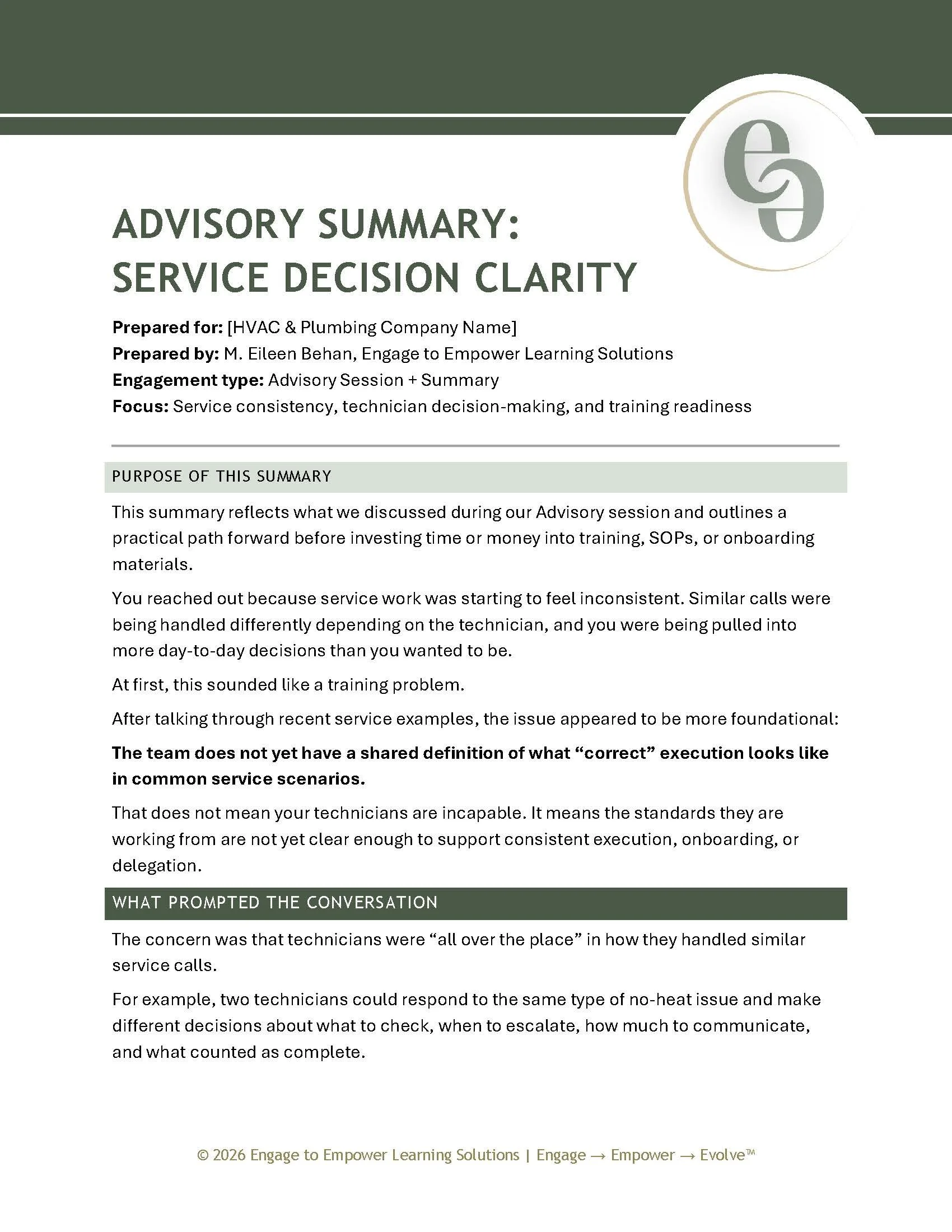
After the Advisory session, the client received a written summary that clarified what was actually causing the inconsistency, what should be defined before training, and what the next practical decision should be.
Representative example. Final deliverables vary by scope.
What Changed
Instead of building training right away, the owner shifted to defining expectations first.
That gave the business a clearer starting point before investing in SOPs, onboarding, or training materials. It also helped reduce owner dependency by showing which service decisions needed a shared standard — and which areas could still allow technician judgment.
The value of the Advisory session was not a large deliverable.
The value was helping the owner avoid building the wrong solution.
This helped replace:
jumping straight into training without clear standards
repeated mid-job calls and texts to the owner
inconsistent service decisions across technicians
callbacks caused by variation in execution
reliance on individual experience instead of shared expectations
Investment
$500 — Advisory Session + Summary
This included a focused Advisory conversation and a written summary identifying the likely clarity gap, what needed to be defined before training, and the recommended next step.
Start with clarity before you build.
A focused Advisory session can help clarify whether the issue is training, documentation, communication, or unclear expectations — before you invest in the wrong solution.
Representative Scenario Note: This example is a representative scenario based on real client work and common patterns across similar organizations. Details have been adjusted for clarity and confidentiality.