ONBOARDING · SEASONAL WORKFORCE ONBOARDING AND PERFORMANCE SUPPORT
Knowledge That Stays With the Farm
A printed training and reference that moved tour-guide know-how out of a few people's heads, so every new guide at a seasonal agritourism farm can use it from the first shift.
CLIENT
Kelkenberg Farm of Clarence, an agritourism farm
PROBLEM
Tour know-how lived with the longest-tenured guides
MY ROLE
Tour guide, documentation advisor, training designer and writer
DELIVERABLE
Printed training and reference packet
Client work, named with permission.
The Problem
The farm needed two different things, and one document could not do both.
When I started as a guide, I noticed several things that would have been easier with materials. Everyone around me had years more experience, so I built my own cheat sheet and kept going.
The next season, normal turnover changed the picture: I was suddenly the most tenured guide on the team. The farm's tour knowledge had been leaving with each person who moved on, and the farm had started building its first real employee handbook.
A handbook sets expectations, rights and boundaries. It cannot teach a new guide how to run a tour. The onboarding gap was a knowledge-capture problem: get what experienced guides knew onto paper, in a form a nervous first-week guide could use.
What I Decided and Why
1 Sort the documents first.
I audited the handbook draft and explained what belongs in a handbook, SOPs, onboarding and appendices, and which parts an employment attorney should review.
2 Learn, Practice, Look Up.
Guides can see what to learn before a first shift and what they only need to look up later.
3 One teaching pattern at every stop.
Connect, Show, Ask, Adapt gives a new guide a reliable way to run any station, even one they have seen only once.
4 No script, and a daily check.
Consistency means the same safety rules, accurate core messages and respectful animal treatment. The wording stays the guide's own, and the packet says what to confirm before each tour.
What It Changes
For the Farm
The tour knowledge stays when a guide moves on, and when animals or routes change, the farm updates one reference.
For the Owners
The handbook stays focused on expectations, which keeps it easier to maintain and to review.
For Guides
One place to learn the route, the rules and the teaching thread before the first tour. Visiting groups get the same safety rules whichever guide leads.
The Work
The packet includes a tour flow map, a page for each stop with farm facts, a key idea and a suggested question, a quick-reference section, a deeper fact bank, and practice questions to talk through before a first tour.
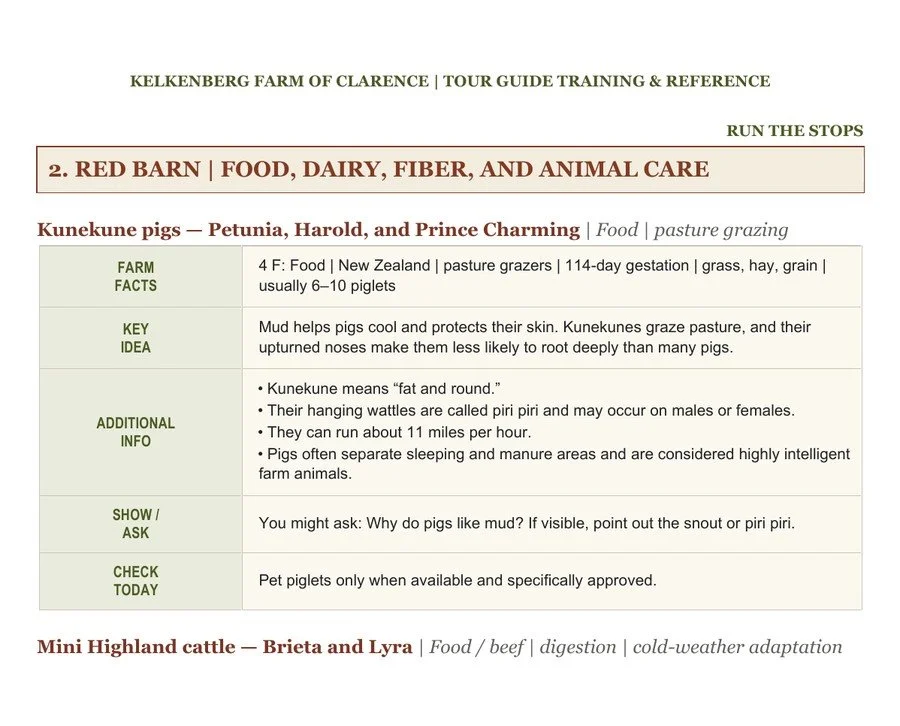
A page for every stop
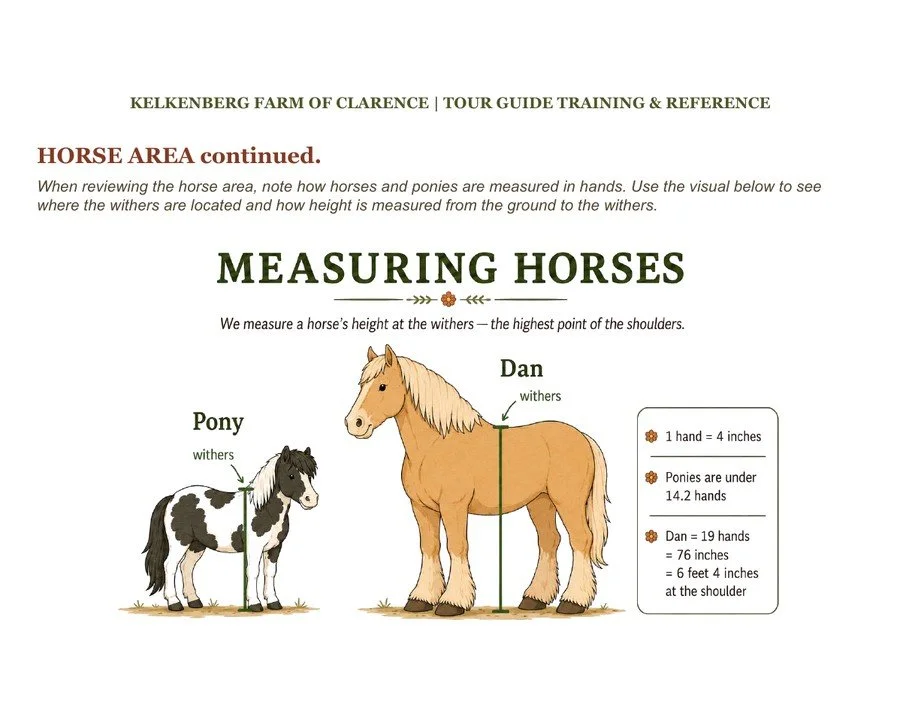
Visuals that teach on the spot
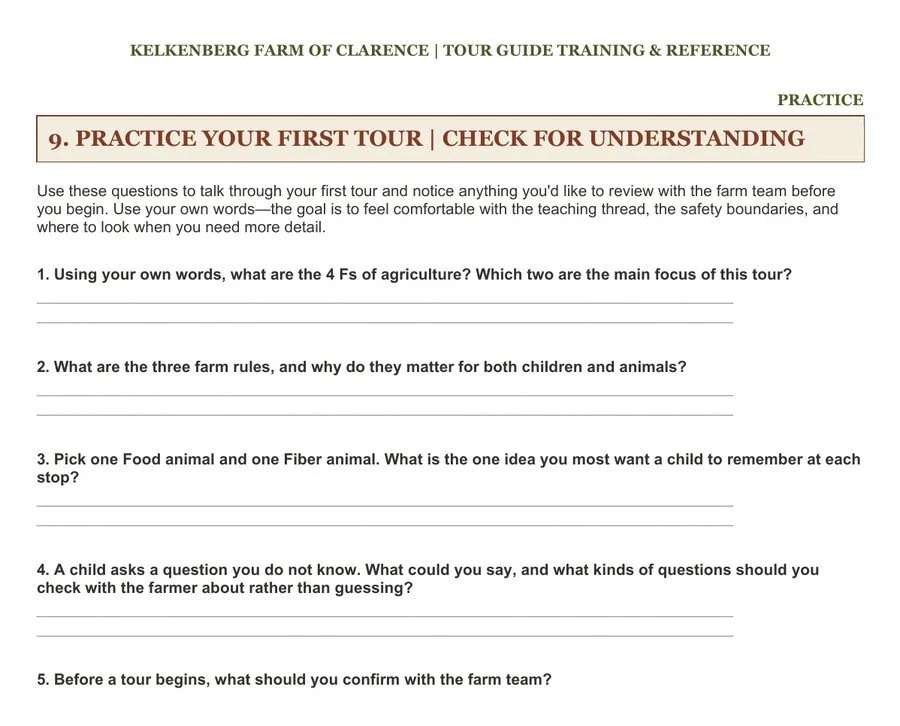
Practice before the first tour
If your seasonal or part-time staff turn over faster than you can train them, let's talk.
Book a 30-minute call and bring the role you have to train for every season.
Skills shown: Knowledge capture · Onboarding design · Seasonal and part-time workforce training · Performance support · Job aid design · Documentation structure · Instructional writing · Visual layout