
Discovery → Understand the System
Representative scenario based on real client work. Names and details are changed.
When onboarding exists but outcomes still vary, Discovery helps identify what is actually causing the inconsistency before time and money go into the wrong solution.
When onboarding existed but outcomes still varied, the real issue was understanding where the system depended too heavily on interpretation.
Quick Snapshot
Business: 120-person insurance brokerage
Problem: Inconsistent onboarding outcomes across teams and offices
Service path: Discovery
Timeline: 2–3 week diagnostic engagement
Representative investment: $6,500
Representative deliverables: Learning Infrastructure Blueprint, supported by a Discovery Decision Roadmap, Assessment Matrix, and Priority Action Plan
What changed: Leadership identified the most likely sources of variation and gained a focused path forward
Discovery
What This Clarified
The Situation
A 120-person insurance brokerage had already invested in onboarding and internal training, but results varied significantly across teams and offices.
Some new hires became productive quickly and handled client interactions well. Others struggled, relied heavily on managers, and created inconsistent client experiences.
The organization had training materials. It had managers who cared. It had a clear desire to improve.
But the outcomes still depended too much on who delivered the onboarding, which office the new hire joined, and how each manager interpreted the expectations.
Leadership was unsure whether the answer was to rebuild training or fix something deeper.
The situation could be summarized simply:
“It works when the right people are involved. It just doesn’t work the same way everywhere.”
That was the central issue.
The problem was not that training did not exist. The problem was that the broader onboarding system was not producing consistent results across teams.
Why Discovery Was the Right Fit
Moving directly into a training rebuild would have meant changing materials before leadership understood why onboarding outcomes were varying.
The organization did not need another content-first solution. It needed a clearer view of how the onboarding system was functioning across teams, offices, managers, and real client-facing situations.
The immediate question was not:
“How do we rebuild onboarding?”
It was:
“Where is the system relying too heavily on manager interpretation, informal reinforcement, or implied expectations?”
Discovery was the right fit because it created a structured view of what was working, what was unclear, where variation was entering the system, and which issues should be addressed first.
That helped leadership avoid treating every onboarding problem as a course-development problem.
What I Did + What They Received
I helped the organization clarify:
where onboarding outcomes varied across teams and offices
which expectations were clearly defined and which remained implied
where managers were filling gaps through individual interpretation
where existing materials supported the work and where they were disconnected from it
where new hires needed decision support, practice, or reinforcement
which issues required clarification before any rebuild began
The organization received:
a Learning Infrastructure Blueprint
an executive summary of the current-state pattern
key Discovery findings organized by treatment level and priority
a Discovery Decision Roadmap showing what to preserve, clarify, reinforce, defer, or build next
a Learning Infrastructure Assessment Matrix showing current state, risk, treatment level, and priority
a Priority Action Plan with recommended actions, decision owners, and success indicators
clear post-Discovery options for a focused build, phased implementation, or continued internal action
Representative Deliverable
Learning Infrastructure Blueprint
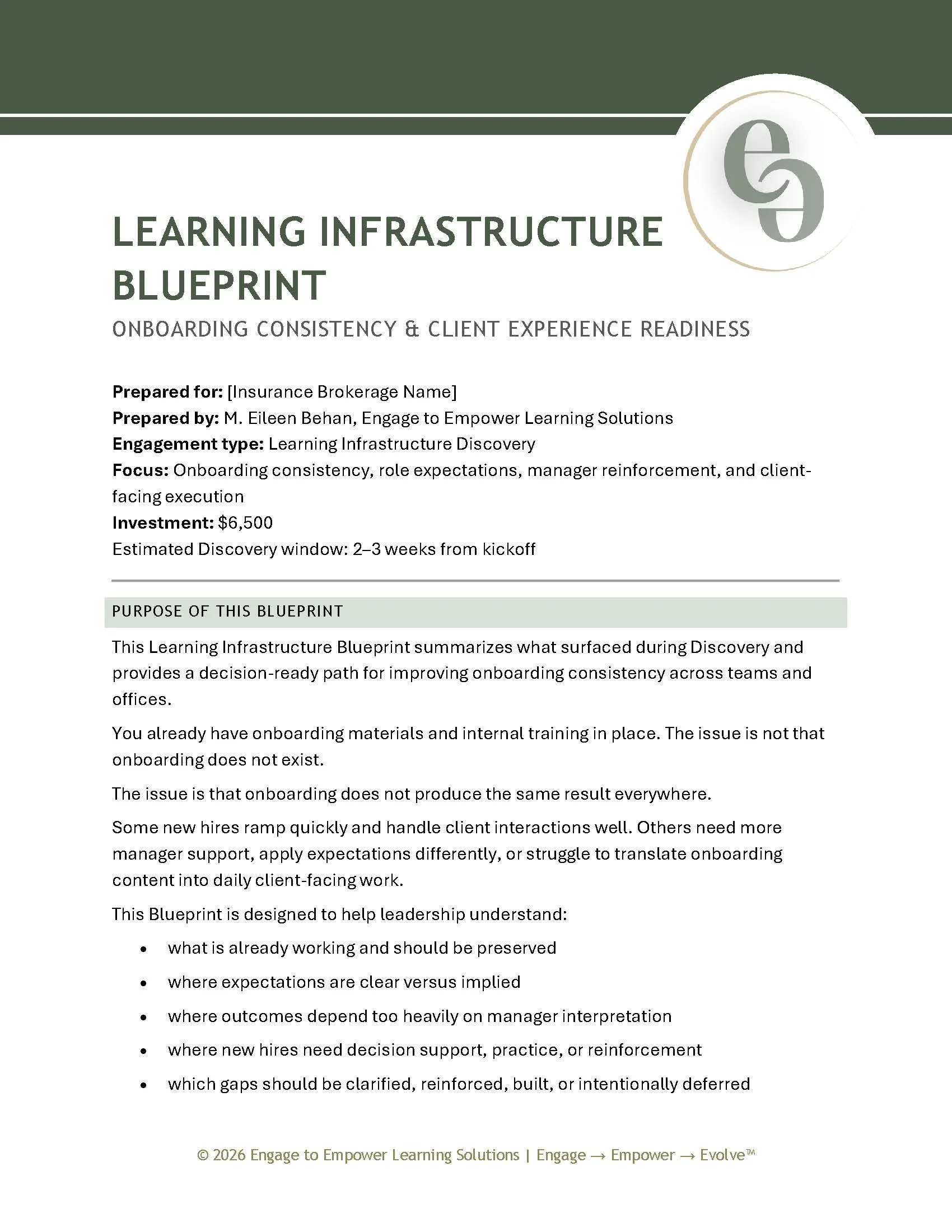
After Discovery, leadership received a decision-ready blueprint that clarified what was working, where outcomes depended on interpretation, and what should happen before any major training rebuild was approved.
The blueprint showed:
where onboarding expectations were clear and reusable
where managers were interpreting standards differently
where new hires were expected to guess, ask, or escalate
which gaps created the greatest risk or inconsistency
what should be preserved, clarified, reinforced, or deferred
Representative example. Final deliverables vary by scope.
What Changed
The immediate shift was from rebuilding onboarding to understanding why the existing system produced different outcomes.
Discovery gave leadership a clearer picture of what was worth keeping, which gaps needed clarification, and where future work would create the most value.
The value of the engagement was not that it produced more training. It was that it helped leadership make better decisions about what should be fixed, reinforced, or built next.
The recommendations were designed to address:
rebuilding training without identifying the source of inconsistency
continued variation across teams and offices
reliance on individual managers to fill system gaps
repeated updates to materials that did not change performance
unclear priorities competing for time and budget
investment in broad solutions when a narrower intervention might be more useful
The recommended next step was a focused implementation sequence based on risk, business priority, and the type of support each gap required.
Investment
$6,500 — Learning Infrastructure Discovery
Scope included multi-role review across teams, onboarding materials, and workflow analysis.
This included a diagnostic review of existing materials and onboarding structure, identification of where expectations were unclear or inconsistently applied, and a decision-ready blueprint for next steps.