REPRESENTATIVE PERFORMANCE-SUPPORT PROJECT
Customer Intake Quick-Reference Checklist
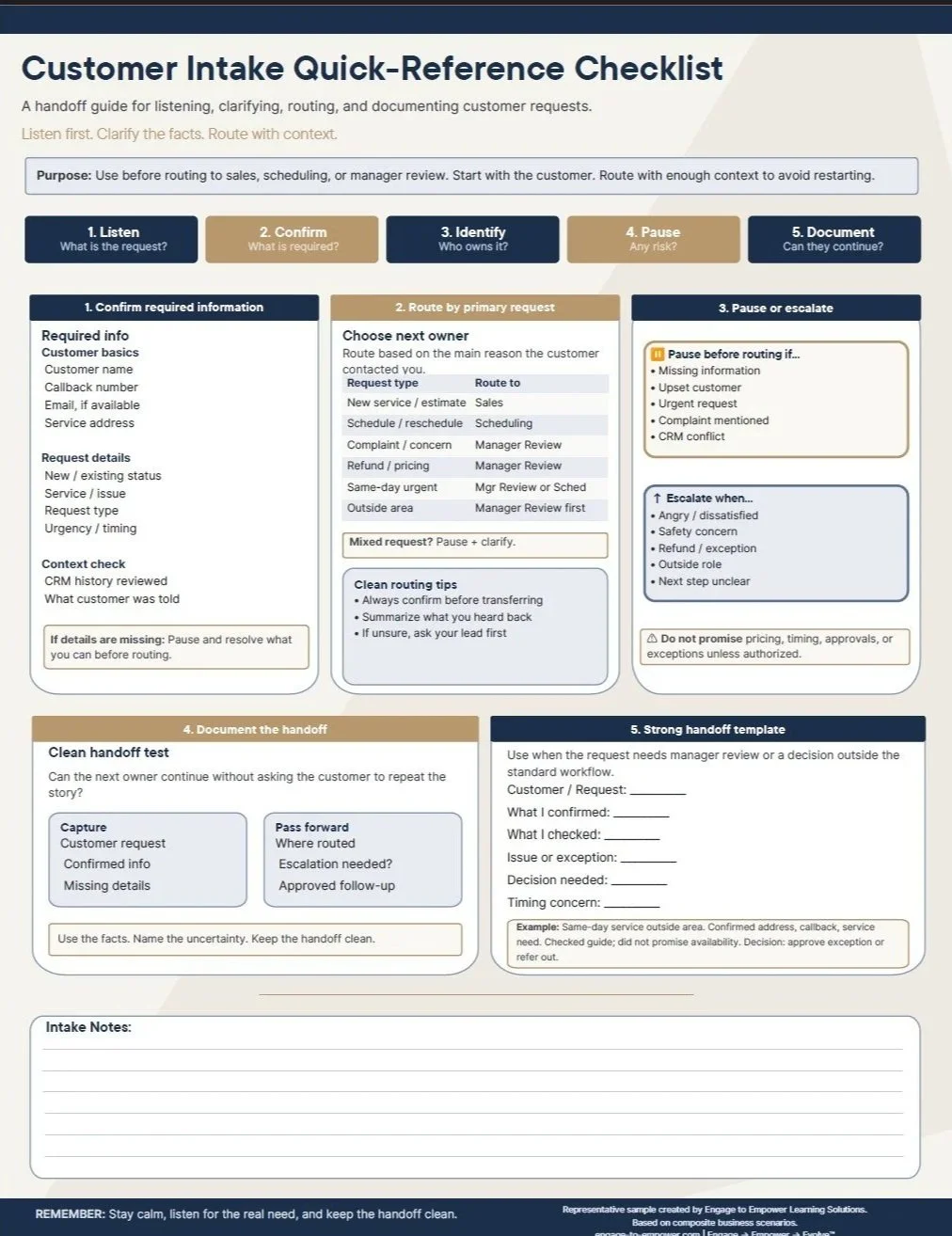
A one-page performance-support tool designed to help employees listen, clarify, route, and document customer requests without losing context along the way.
Quick Snapshot
Organization: Residential property management company
Challenge: Customer requests were being routed with missing details, unclear ownership, and inconsistent documentation.
Work: Performance-support design and development
Deliverable: One-page customer intake quick-reference checklist
Learning focus: Support employees while listening, clarifying, routing, and documenting customer requests
Tools: Information design, visual design, and PDF development
Good intake gives the next person enough context to continue.
The Situation
Customer requests were being received, but the quality of the information varied.
Some employees captured enough detail for the next person to continue. Others routed requests with missing information, unclear ownership, or notes that forced the customer to repeat themselves.
That created avoidable back-and-forth, inconsistent handoffs, and greater dependence on experienced employees to recognize what was missing.
The need was not more training content. Employees needed a practical tool they could use during the conversation to clarify the request, choose the right next owner, and document the handoff clearly.
The Design Decisions
Follow the Work
The checklist mirrors the sequence employees move through while listening, clarifying, routing, and documenting a request.
Keep It Scannable
Information is grouped into short sections so employees can find the right prompt without slowing down the conversation.
Make the Standard Visible
Clear checks and decision points reduce dependence on memory and informal explanation.
Explore the Finished Work
Customer Intake Quick-Reference Checklist
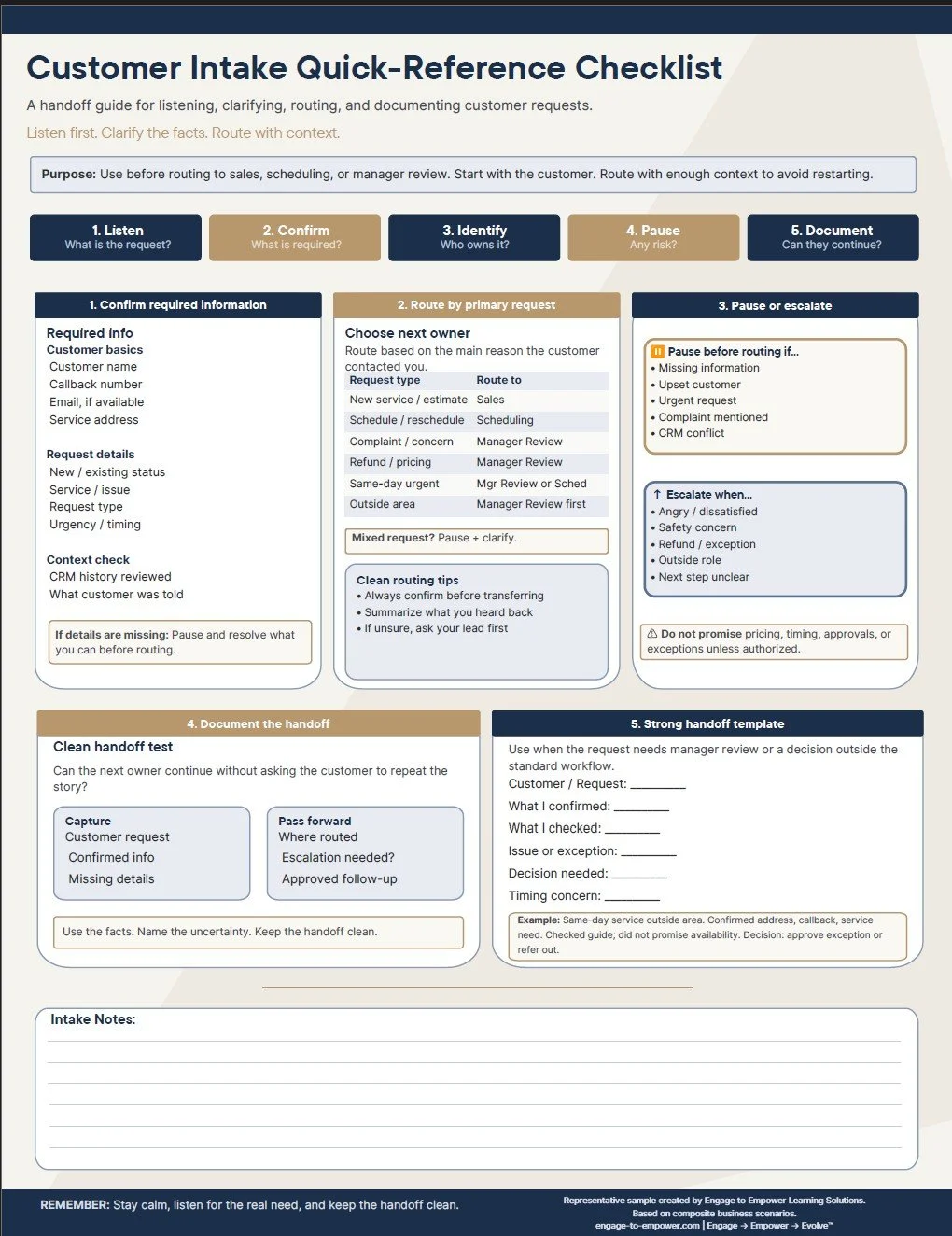
This one-page job aid gives employees a practical sequence for handling customer requests from the first conversation through the final handoff.
It brings the most important checks, routing decisions, escalation points, and documentation prompts into one place so employees can move the request forward without losing context or asking the customer to start over.
Opens in a new tab.
Why a Job Aid
The support needed to be available while employees were handling the request—not only after they completed training.
A one-page format keeps the key questions and decisions close to the work. Employees can quickly confirm required information, identify the right next owner, recognize when to pause or escalate, and document a handoff the next person can continue.
The checklist does not replace judgment or a complete procedure. It makes the most important parts of the process easier to see and apply in the moment.
What This Sample Demonstrates
Performance-Support Design
point-of-need support
workflow translation
process clarification
job-aid writing
decision support
alignment with day-to-day work
Visual Development
information hierarchy
concise instructional copy
one-page document design
scanability and usability
PDF production
brand-aligned visual design
Make the right action easier to see.
Training can introduce a process. Performance support helps employees use it while the work is happening.
Portfolio note: This sample has been recreated and anonymized for portfolio use. Names, identifying details, and proprietary content have been changed, while the underlying performance need, design decisions, and deliverable remain representative of the work.